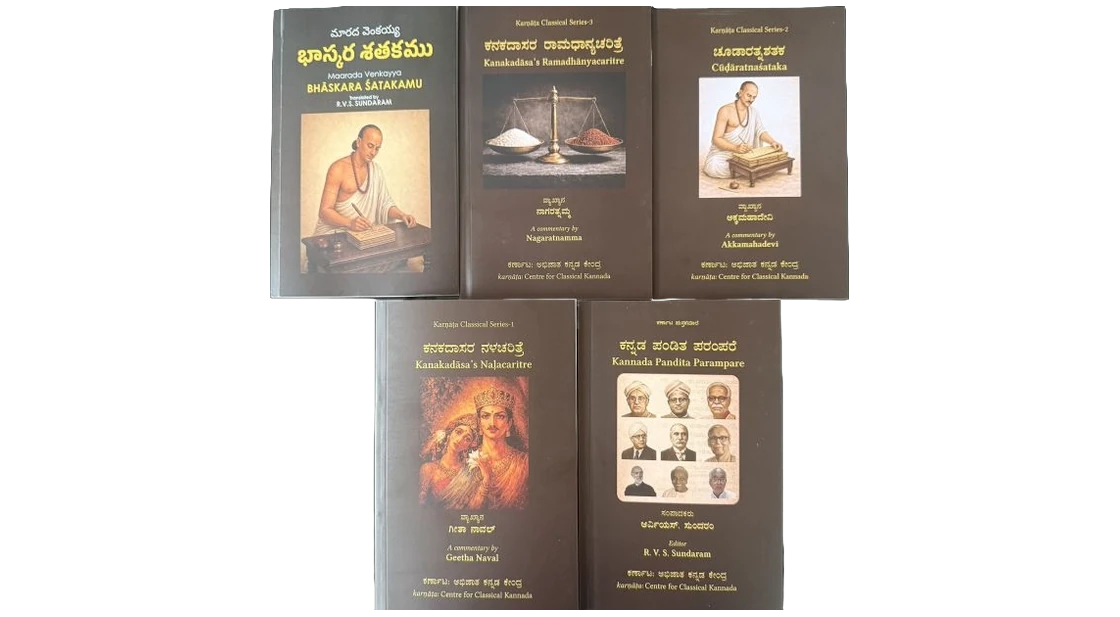
Tattva Heritage Foundation is glad to report the publication of five volumes this year — four in Kannada, released in July, and one in Telugu, published this month.
The Kannada volumes come from karṇāṭa: Centre for Classical Kannada, Mysore. karṇāṭa conceives and edits its own publication programme; Tattva Heritage Foundation publishes its volumes, as it does the other books the Foundation commissions.
Three belong to the Karṇāṭa Classical Series, edited by R. V. S. Sundaram, which presents critical Kannada commentaries intended to make important classical texts accessible to modern readers. The first is a commentary by Geetha Naval on Kanakadāsa’s Naḷacaritre, a narrative poem in nine chapters and 481 verses retelling the story of Nala and Damayantī from the Nalopākhyāna. The second is a commentary by Akkamahadevi on the Cūḍāratnaśataka, an anonymous nīti śataka in kanda metre. The third is a commentary by Nagaratnamma on Kanakadāsa’s Rāmadhānyacaritre, the satirical debate between rāgi and rice, adjudicated by Rāma in rāgi’s favour.
Alongside the series, karṇāṭa has published Kannada Paṇḍita Parampare, a biographical volume devoted to sixty eminent Kannada scholars who shaped the study, interpretation and transmission of classical Kannada learning. Each is treated in a substantial essay on his intellectual formation, major works and contributions, written by a scholar of that field. Together the essays amount to an introduction to the Kannada scholarly tradition itself.
The fifth volume, published this month, is an English translation of the Bhāskara Śatakamu by R. V. S. Sundaram. One of the most widely read of the Telugu nīti śatakas, it is traditionally attributed to Mārada Venkayya and composed in the utpalamāla and campakamāla metres. Each verse is built in two parts — a general precept in the first half, an illustration drawn from the epics and purāṇas in the second — a structure so distinctive that the tradition generated legends about the poem’s composition in order to account for it. The translation is accompanied by an introduction on the question of authorship, the metrical form, and the poem’s relation to the older Sūrya Śataka of Mayūra.
Some of these books are avaialble to buy online. All these books will also soon be available in open access on this website.